


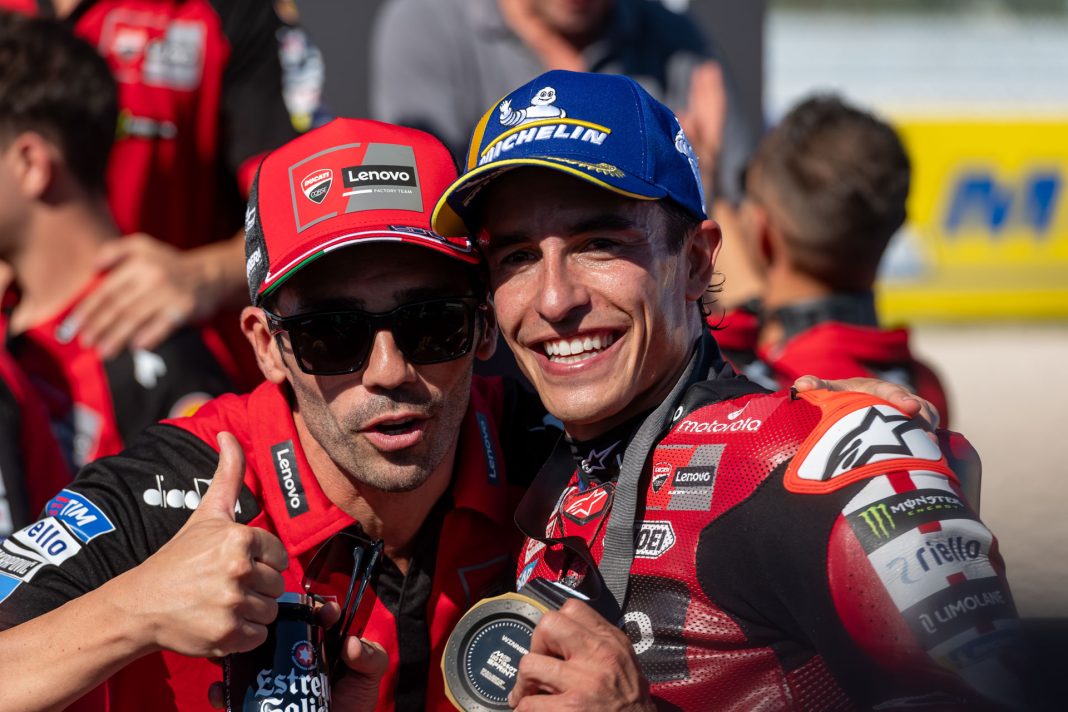

Marc Márquez has written yet another indelible chapter in the history of motorcycling. By clinching the 2026 world title at the Portuguese Grand Prix, the Ducati Lenovo Team rider joins Giacomo Agostini on eight premier-class championships, completing a comeback that had seemed virtually impossible just a few months earlier.
The Spaniard had, in fact, found himself trailing Marco Bezzecchi – the championship leader and star of a particularly competitive season with Aprilia – by a staggering 102 points. It was a huge gap, compounded by physical problems and the difficulties encountered in the first part of the year, which seemed to have definitively compromised his chances of defending the title he had won in 2025.
Yet, at the very moment when things were at their most difficult, Márquez and Ducati found the strength to fight back, staging a comeback destined to go down in the annals of MotoGP.
Marquez changes his mindset: less instinct and greater clarity
Throughout his career, Marc Márquez has built his legend on an aggressive riding style, borderline overtaking manoeuvres and an almost obsessive determination to seek victory in all conditions.
In 2026, however, the Spanish champion had to learn a completely different lesson: to win a World Championship, it is not always necessary to be the fastest; above all, one must understand when to attack and when to settle for less.
After clinching the title at Portimão, Márquez acknowledged that he had fundamentally changed his approach to races, learning to control that instinct which for years had been one of his main strengths.
Compared to the 2025 season, in which he had often managed to assert his superiority through sheer speed, the new championship has required much more careful management of energy, risks and opportunities.
Accepting fifth or seventh place, rather than risking a crash in an attempt to reach the podium, has become an integral part of the Spaniard’s strategy.
This change was also evident at the Portuguese Grand Prix, where Márquez finished Sunday’s race in eighth place, avoiding unnecessary risks following his crash in Saturday’s Sprint race.
A performance far removed from his usual ambitions, but sufficient to mathematically secure his second consecutive title with Ducati.
The turning point at Mugello: Ducati refuses to give up despite a 102-point deficit
Whilst Marquez’s change in mindset was one of the decisive factors in winning the World Championship, another crucial moment is identified within the Ducati: the Italian Grand Prix at Mugello.
It was precisely at that stage of the season that the gap to Marco Bezzecchi had reached 102 points, fuelling doubts about the Spaniard’s chances of a comeback.
Aprilia had proved extremely competitive, frequently putting the Desmosedici under pressure and shattering that sense of technical superiority which had characterised the Borgo Panigale-based manufacturer’s previous seasons.
Team manager Davide Tardozzi explained how that very situation provided further motivation for the whole team.
Rather than writing off the championship as a lost cause, Ducati continued to work with determination, convinced that Márquez could still turn the standings around.
The Spaniard’s comeback took on historic proportions, even surpassing the previous record set by Francesco Bagnaia in 2022, when the Italian rider managed to make up 91 points on Fabio Quartararo before clinching his first title in the premier class.
By making up 102 points, Márquez has therefore set a new benchmark in the history of MotoGP.
From injuries to a comeback: seven wins in thirteen Grand Prix races
The significance of this achievement becomes even more apparent when one considers the physical difficulties faced by the Spanish rider during the championship.
Márquez had been forced to undergo further surgery following the injuries sustained during the French Grand Prix weekend, a situation that had jeopardised the continuity of his season.
His return to the track at Mugello, which ended with a cautious seventh place, did not immediately suggest the possibility of such a significant comeback.
As his physical condition gradually improved, however, the Spaniard regained his competitiveness, managing to combine his pace with a more measured approach to the races.
In the following thirteen Sunday races, Márquez claimed seven victories, gradually closing the gap on his rivals until he completely turned the standings on their head.
This run of results was particularly significant given the competitiveness of Aprilia, with Marco Bezzecchi and Jorge Martin repeatedly putting the Ducati under pressure.
In the long run, the difference was down to Márquez’s ability to capitalise on favourable opportunities without compromising his result on the more challenging race weekends.
Ducati acknowledges Aprilia’s strength: a World Championship won against a formidable opponent
Despite the celebrations for the world title, Ducati made no secret of his respect for Aprilia, whose technical progress made the 2026 championship particularly hard-fought.
Davide Tardozzi acknowledged the achievements of the Noale-based manufacturer, emphasising how, on several occasions, the RS-GP proved to be extremely competitive, at times even outperforming the Desmosedici.
It is precisely the calibre of the opposition that makes the result achieved by the Borgo Panigale team all the more significant.
For Ducati, this marks their fifth consecutive riders’ title, a milestone that confirms the strength of the Italian manufacturer’s racing programme.
Test rider Michele Pirro also highlighted the special significance of this success, which came in the final season of the current technical regulations featuring 1000 cc engines.
From 2027, in fact, MotoGP will enter a new era with the introduction of 850 cc engines, making the title won by Marquez an even more symbolic achievement for Ducati.
Marquez’s psychological transformation: learning to manage the pressure
One of the most interesting aspects to emerge from the Spanish champion’s reflections concerns mental preparation.
Marquez explained that he had focused more on managing pressure, changing certain habits during race weekends to maintain concentration and minimise distractions.
Ducati has learnt to carve out moments for himself, limiting external pressures and seeking a balance that allows him to approach races with greater composure.
Another important change concerned the management of his physical condition.
After years marked by injuries, operations and long periods of rehabilitation, Márquez realised how crucial it was to respect recovery times and avoid overexertion.
The support of his family, his brother Alex Márquez, his partner and the entire Ducati team helped to keep his confidence high even during the most difficult moments.
The result has been a rider capable of retaining the talent and aggression that made him famous, whilst combining them with a far greater sporting maturity.
Eight titles in the premier class: Márquez equals Agostini and overtakes Rossi
With his victory in 2026, Marc Marquez joins Giacomo Agostini on eight world titles in the premier class, further cementing his place amongst the greatest riders in the history of motorcycling.
The Spaniard also brings his total number of world championships won in his career to ten, including his successes in the 125cc and Moto2 categories.
This achievement takes on even greater significance when one considers the serious injury to his right arm in 2020, which marked the start of a long period of operations, physical difficulties and uncertainty about his competitive future.
Six years on, Márquez has not only returned to the top of the MotoGP but has also managed to win two consecutive titles with Ducati, demonstrating an extraordinary ability to adapt.
The 2026 World Championship may not be remembered as his most dominant season in terms of sheer speed, but it certainly represents one of the most significant achievements of his career.
A victory built on patience, determination, teamwork and profound personal growth.
Marc Marquez has always known how to win thanks to his talent and his ability to push beyond the limit. In 2026, he demonstrated that, to become even greater, one must also learn when that limit must not be crossed.
And it is precisely this new realisation that has transformed a seemingly lost season into one of the most extraordinary achievements in the history of the MotoGP.