

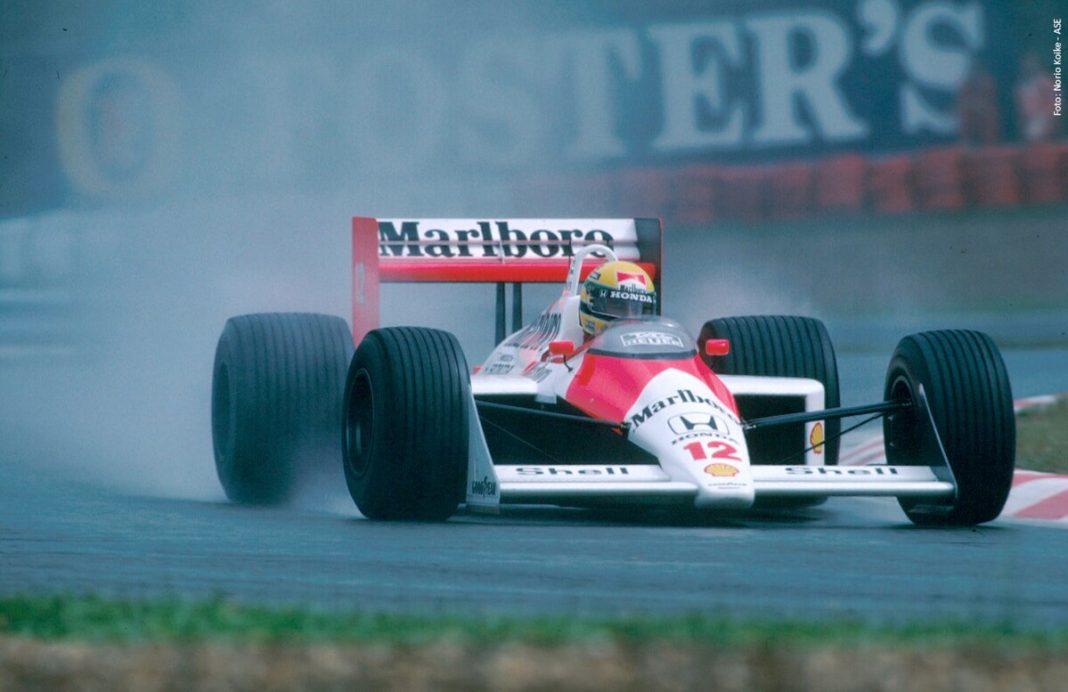

“A racing car is beautiful only when it wins.” This definition comes from Enzo Ferrari, the “Drake” of Maranello—an individual who unquestionably knew a thing or two about racing cars. That quotation came to mind when the new McLaren first appeared, as certain details immediately raised eyebrows and revealed the haste with which the car had been completed after recent delays, simply to take to the track at Imola.
Only a few hours later, however, the new McLaren-Honda MP4/4 delivered the best—and only—possible response a racing car can give, as it set truly remarkable lap times, even though the infamous FISA boost-limiting valve was not yet installed.
Only a few hours later, however, the new McLaren-Honda MP4/4 delivered the best—and only—possible response for a racing car, setting truly remarkable lap times (although it should be noted that the infamous FISA boost-limiting valve was not yet installed).
Traditional yet entirely new—apart from the wheels—the MP4/4 was designed by Steve Nichols, for years the right-hand man of John Barnard. This was the English engineer’s first true Formula 1 car, having been responsible since the previous season for the development of the McLaren MP4/3. In order to continue parallel programmes with two different engines, the Woking team had in any case decided to divide responsibilities.
Evolution or revolution? If a judgement must be made, the McLaren-Honda MP4/4 can be described as a profound evolution of the previous MP4/3, with which it shares many components. Let us nevertheless analyse in detail what would go on to become one of the greatest single-seaters in Formula 1 history.
Chassis
While respecting the construction principles typical of McLaren monocoques, the MP4/4 chassis is entirely new. Since September 1986, the British team had been manufacturing its chassis in-house (previously they were produced by Hercules in the United States), and the latest examples were naturally built within Ron Dennis’s ultra-high-tech factory.
Steve Nichols, while retaining the same construction technique (the monocoque separated from the bodywork), took the opportunity to create a stiffer structure, particularly in the cockpit area. This section is taller, with a reinforcing band running along the side of the driver. The lines of the MP4/4 chassis are characteristically angular and differ noticeably from those of the MP4/3.
The most striking feature of the new monocoque is its completely squared-off U-shaped lower section, abandoning the V-shaped form of the previous car, whose structure dated back to 1981—an era of sliding skirts and very narrow lower chassis sections. Nichols followed the trend towards narrow monocoques, but without excess, to the extent that he was able to retain vertical dampers within the chassis. These were positioned further rearward to gain a few centimetres of cockpit space.
The rear portion of the MP4/4 chassis is extremely short, with a fuel-tank area reminiscent of the Williams FW08 that won the 1982 World Championship with Keke Rosberg. The finishing of this first example left something to be desired, particularly in the detachable frame of the front deformable structure.
Low, narrow and streamlined, the MP4/4 recalls the Brabham-BMW BT55—a revolutionary but unsuccessful creation designed by Gordon Murray in 1986. The similarities with Murray’s car are evident in technical drawings, especially in the very low engine cover, which features a distinctive “hump” towards the rear.
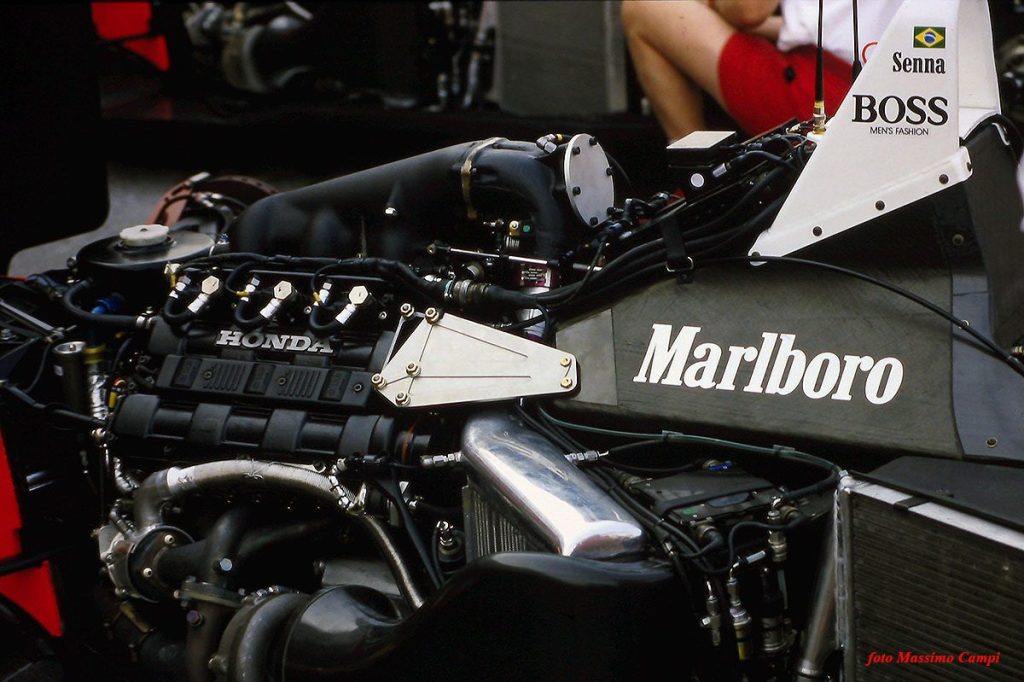
Cockpit
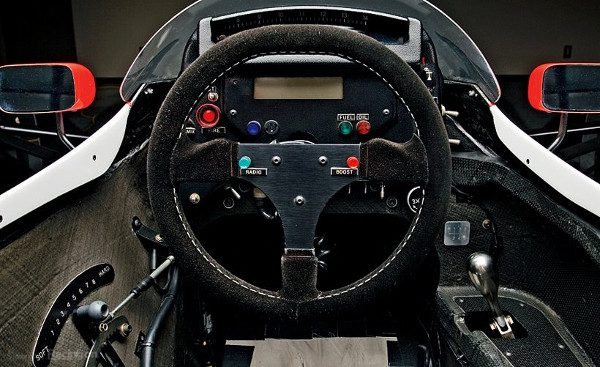
The cockpit of the new McLaren-Honda MP4/4 is narrow across the shoulders yet surprisingly spacious inside. What is most striking is the near absence of a central cockpit surround. The driver sits in a highly reclined position and is not enveloped by extensive bodywork as on other cars.
The lateral helmet protections are very low and run along the shoulders, which themselves protrude from the cockpit. The steering wheel is circular in shape, and the instrument cluster is housed in a single unit. The roll-over structure is no longer tubular, as on previous models.
Aerodynamics
There were no leaps into the unknown in the aerodynamic design of the MP4/4. It represents a logical evolution of the concepts successfully expressed by the previous model, which had remained in service—largely unchanged—for over seven years.
The aerodynamics of the MP4/4 were very traditional compared with rival cars. The rear section in particular recalls the MP4/3, although the lower bodywork is entirely different, and the diffuser profiles are closer to those of the previous year’s Williams than to McLaren’s own 1987 design.
The most significant changes are found at the front, which is narrower and more elongated in compliance with new regulations. The nose is slim but not extreme, and appears longer than it actually is, given that the MP4/4 is only four centimetres longer than its predecessor.
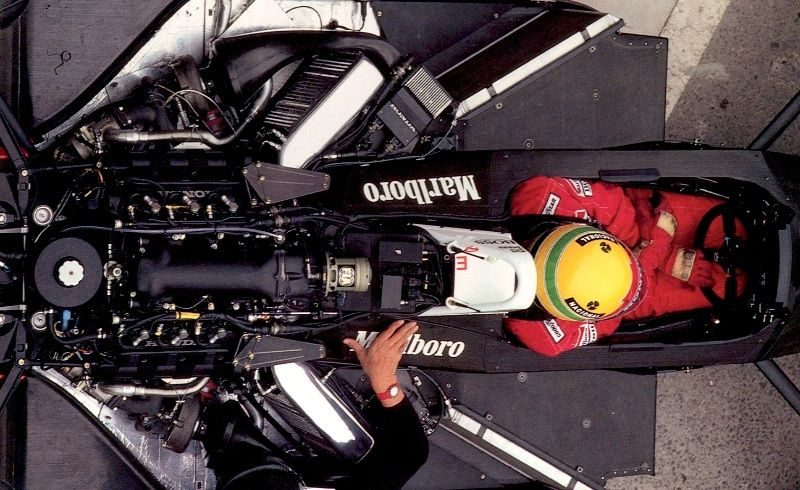
Nichols avoided pushing the limits of the permitted frontal cross-section, unlike several other teams. The narrowing of the front did not lead to a curved widening of the central monocoque—as seen on the Benetton-Ford and Leyton House-Judd—but instead followed a straight, linear expansion similar to that adopted on the new Williams-Judd.
The sidepods remain largely unchanged, featuring lateral outlets for hot air, which at Imola were heavily restricted. Two versions of turbo intake were available: one with the traditional periscopes seen at Imola, and another with internal sidepod ducting already tested the previous year by Williams and Lotus.
The reduced fuel tank capacity—just 150 litres—allowed the bodywork to sit closer to the rear wing. The engine cover appears more streamlined and lower than before, ensuring that airflow towards the rear wing is not compromised.
As for the wings, the reduced engine power led to profiles with smaller chord lengths, although they were derived from those used in the previous season. Without resorting to excessive fuel storage alongside the driver, Nichols succeeded in keeping the overall dimensions of the MP4/4 very similar to those of the 1987 cars. The wheelbase is only about four centimetres longer, aided by the fact that turbo cars in 1988 carried 4.5 litres less fuel than in 1987, resulting in a significantly shorter fuel tank.
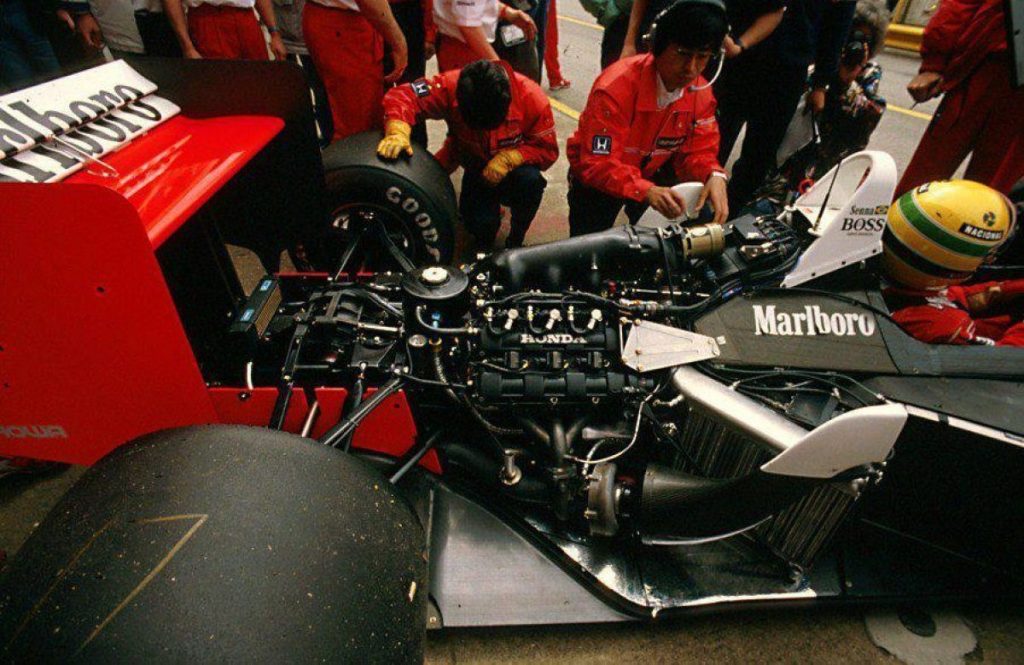
Suspension
The rear suspension is almost unchanged, although a wider-based rocker replaces the conventional push-rod lever. The uprights, front and rear, are welded and very similar to those used the previous year, but feature a revised brake-cooling system.
Notably, McLaren retained its in-house double brake calipers. At the rear, these are mounted at an angle relative to the upright, with the rear caliper positioned higher than the front one.
The front suspension, by contrast, is entirely new—not only in layout, switching from push-rod to pull-rod, but also in design. Instead of a narrow-based upper wishbone, a very wide one is used, with its outer mounting points attached externally to the monocoque. The lower wishbone is even wider, with the rear arm pivoting inside the chassis itself.
The spring-damper unit—unique among the new Formula 1 cars—is located inside the monocoque but set back from the front axle, providing additional space for the driver’s feet in an area where the chassis is at least 4–5 cm wider. For packaging reasons, the steering column is offset to the left to avoid interference with the brake pedal, while the steering rack is mounted outside the chassis.
It is also worth noting that McLaren switched to Japanese Showa dampers with separate gas reservoirs, replacing the traditional Bilstein units.
Gearbox
David North, brought in by Gordon Murray, worked alongside Pete and Michelle Weismann to design an entirely new longitudinal gearbox with extremely compact dimensions.
Formula 1 cars in 1988 ran very low to the ground; to achieve horizontal driveshafts they would have needed to be raised by at least 20 mm. The new Honda turbo engines, with output shafts 25 mm lower, exacerbated the issue, making it necessary to raise the gearbox to maintain near-horizontal driveshafts.
North solved the problem with a three-shaft gearbox, with all ratios located in the rear section. Immediately after the clutch there is an initial speed reduction, and the primary shaft passes beneath the driveshafts. Gear ratio changes are straightforward.
North, again with the Weismanns, was also studying a new gearbox for the naturally aspirated engine—likely a transverse unit, which would make it even easier to achieve the required 50 mm increase in height. If one weakness can be identified in such a competitive and successful project, it would be the gearbox, which never operated with complete reliability.
Technical Specifications
- Wheelbase: 287.5 cm
- Front track: 180 cm
- Rear track: 167 cm
- Length: 445 cm
- Width: 215 cm
- Weight: 540 kg
- Gearbox: 6 speeds + reverse
- Tyres: Goodyear
- Wheels: 13 inches
- Engine: Honda 1493 cc turbocharged, V6 at 80°
- Turbochargers: Twin, with pressure limited to 2.5 bar
- Maximum power: approx. 890 hp at 12,500 rpm
Victories
Ayrton Senna:
San Marino GP, Canadian GP, United States GP, British GP, German GP, Hungarian GP, Belgian GP, Japanese GP.
Alain Prost:
Brazilian GP, Monaco GP, Mexican GP, French GP, Portuguese GP, Spanish GP, Australian GP.
Drivers’ World Championship:
1st Senna – 90 points
2nd Prost – 87 points
Constructors’ Championship:
1st McLaren – 199 points