

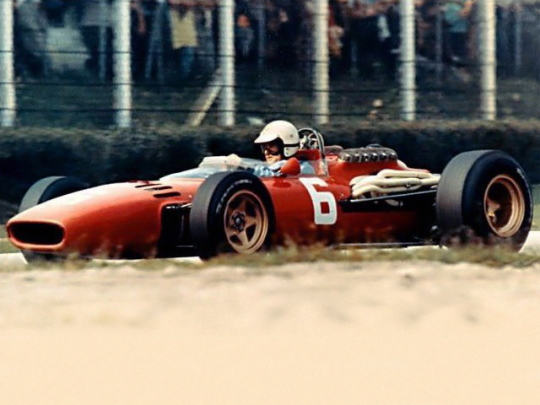

The advent of three-litre Formula 1 engines led to the debut of the Ferrari 312 F1 in 1966. As one of the few manufacturers already prepared with an engine suitable for the new regulations, Ferrari entered the season as a pre-championship favourite for the World Championship.
In November 1963, the CSI (International Sporting Commission) decided that the maximum engine capacity in Formula 1 would be increased from 1,500 to 3,000 cc. Following the withdrawal of Coventry-Climax, the first naturally aspirated three-litre engines were produced by Ferrari, Repco and Maserati, later joined by Ford, BRM, Honda and Weslake. To allow the continued use of 1.5-litre engines, the CSI ruled that this displacement would remain the limit for supercharged units.
At the time, few considered the long-term implications of this decision. Around a decade later, however, advances in metallurgy enabled Renault to demonstrate that this approach was the winning one. Initially intended to end in 1971, the three-litre Formula 1 era instead became the longest-lasting in the sport’s history. Until the end of 1985, naturally aspirated engines of up to three litres were permitted, although by then the superiority of turbocharged engines—despite their halved displacement—had become clear.
Ferrari ultimately missed out on the world title for several reasons, not least the split between John Surtees and the Maranello marque, which occurred shortly after the British driver’s victory in the second race of the season, the Belgian Grand Prix. Ferrari’s absence from the British and Mexican Grands Prix due to strikes also played a significant role.
The 312 F1 nevertheless claimed victory with Ludovico Scarfiotti at the Italian Grand Prix in Monza, while Ferrari finished second in the Constructors’ Championship at the end of the season. The Drivers’ World Championship went to Jack Brabham, who won the title driving a car of his own construction, powered by a Repco V8 engine.
Technical Overview
Ferrari built the 312 F1 around a new three-litre V12 engine derived from the 3,300 cc unit used in the 275 P prototype. Featuring twin ignition, the engine used chain-driven double overhead camshafts. In its initial configuration, it employed two valves per cylinder.
Fuel delivery came via a Lucas direct fuel-injection system. With a bore of 77 mm and a stroke of 53.5 mm, the engine displaced 2,989.6 cc. In its first specification, it produced 325 horsepower, a figure that soon rose to 360 hp at 10,000 rpm, with a compression ratio of 11.8:1. Power was transmitted through a longitudinal five-speed gearbox paired with a ZF limited-slip differential using cam plates.
From an aesthetic standpoint, the 312 F1 closely resembled other Formula 1 cars of the era. Beyond its traditional red livery, it stood out for the shape of its front air intake, similar to that of the earlier 158 F1 and 512 F1.
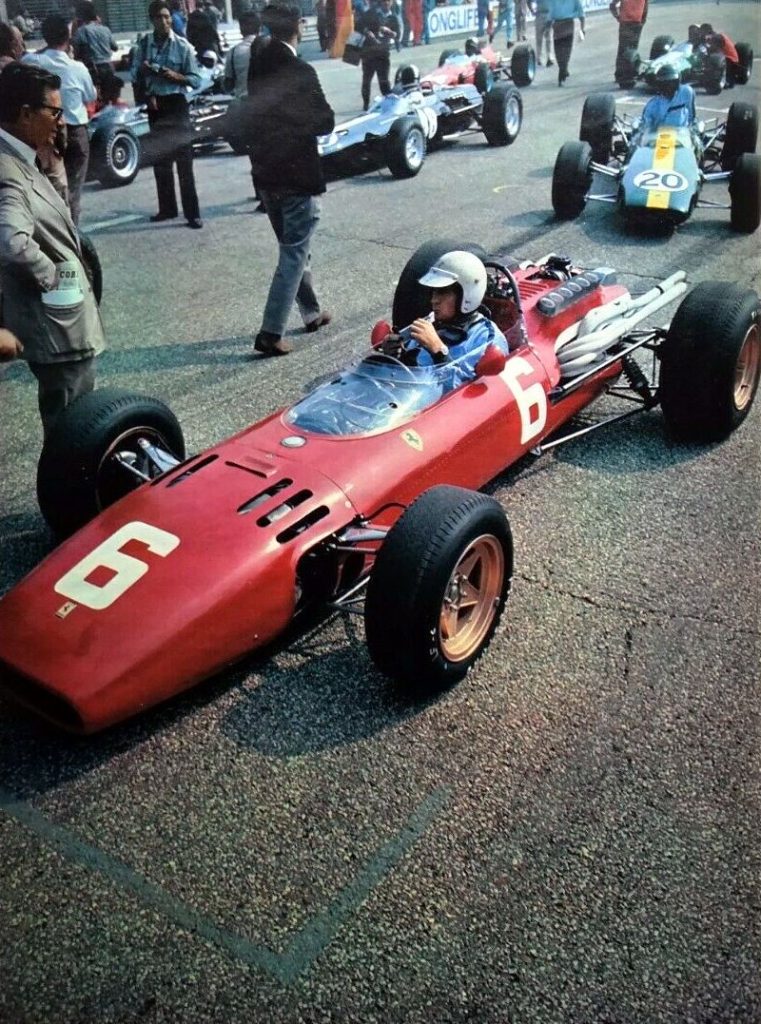
Compared with the first car officially unveiled at the start of the year, later versions featured six air outlets (three per side) positioned near the front suspension. A Plexiglas fairing covered the cockpit, while aerodynamic development was further highlighted by the relocation of the front dampers inside the bodywork—a solution first introduced with the 158 “Aero”.
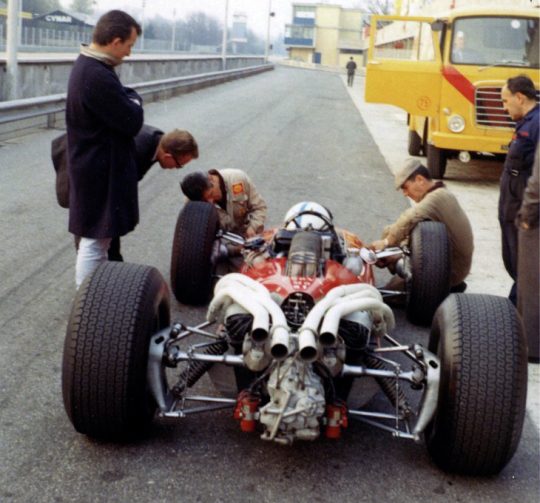
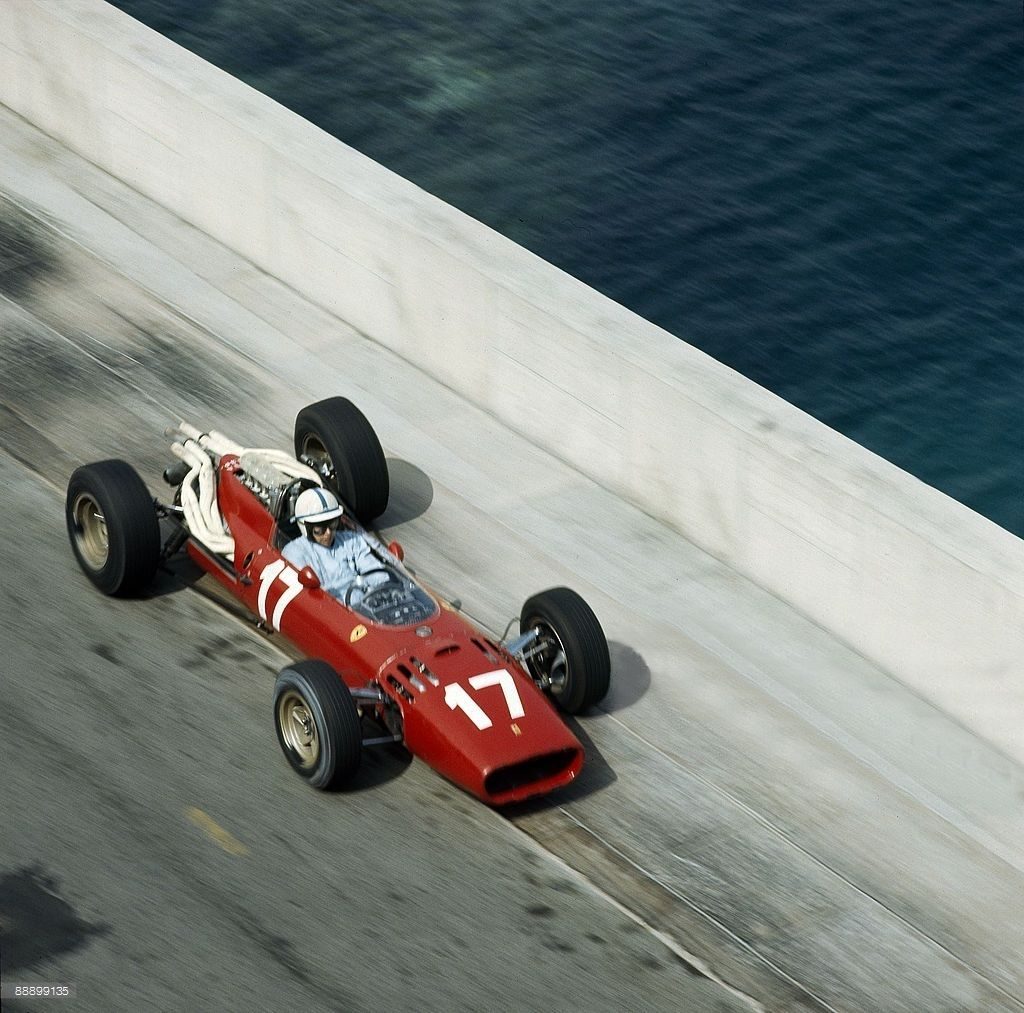
Particularly distinctive were the exhausts: painted white, they wrapped upwards around the rear of the car. The number of exhaust pipes and the twelve intake trumpets positioned between the cylinder banks made it easy to distinguish the 312 F1 from the 246 “Tasmania”. The latter, powered by a 2.4-litre six-cylinder engine, appeared in the World Championship with Bandini at Monaco and Belgium, Scarfiotti at the Nürburgring, and Baghetti at Monza.
Continuing the construction philosophy introduced with the 158, Ferrari equipped the 312 F1 with a tubular spaceframe chassis clad in two aluminium skins, following aeronautical practice. Five rubber fuel cells, with a total capacity of 158 litres, sat along the sides of the car between the aluminium skins.
Racing History
Three weeks later, still driven by Surtees, the 312 F1 contested the Monaco Grand Prix, the opening round of the World Championship. Surtees took the lead at the start, but a differential failure forced him to retire after 14 laps, leaving victory to Stewart in the two-litre BRM. Ferrari salvaged second place with Bandini in the 246.
At Spa-Francorchamps, in a rain-soaked Belgian Grand Prix, Surtees drove the Ferrari 312 F1 to victory. After a torrential downpour on the second lap, only seven of the fifteen starters remained in the race. Stewart suffered a heavy accident at Masta, becoming trapped in his BRM and breaking his collarbone. Surtees finished ahead of Rindt’s Cooper-Maserati and Bandini, once again in the 246. Just ten days later, Ferrari and Surtees parted company in dramatic fashion.
Mike Parkes subsequently joined the Formula 1 team alongside Lorenzo Bandini. Due to Parkes’ height, Ferrari built a third 312 F1 (chassis number 012) with an extended chassis to accommodate him more comfortably.
By then, the 312 F1 had proven itself highly competitive. At Reims, Bandini secured pole position for the French Grand Prix and led the race until a broken throttle cable forced him to retire on lap 31.
A strike by metalworkers prevented Ferrari from attending the British Grand Prix at Brands Hatch. At the subsequent Dutch Grand Prix in Zandvoort, Bandini finished only sixth, three laps down on the winner Brabham. In Germany, at a rain-affected Nürburgring, Bandini again finished sixth as Brabham claimed another victory.
Ahead of the Italian Grand Prix at Monza, Ferrari introduced significant engine updates. The most important change was the adoption of a three-valve-per-cylinder layout—two intake and one exhaust—which increased maximum output to 380 horsepower at 10,000 rpm.
Throughout the season, the 312 F1 also suffered from tyre issues. After testing Goodyear tyres in the Netherlands, Ferrari switched from Dunlop to Firestone starting with the Italian Grand Prix.
At Monza, following the retirements of Bandini and Brabham, who had both led the race, Scarfiotti claimed victory ahead of team-mate Parkes. It was undoubtedly the finest result of the 312 F1’s season.
At Watkins Glen, during the United States Grand Prix, Bandini—Ferrari’s sole entrant—led the opening nine laps before retiring. Ongoing labour unrest then forced Ferrari to miss the final round of the season, the Mexican Grand Prix.