


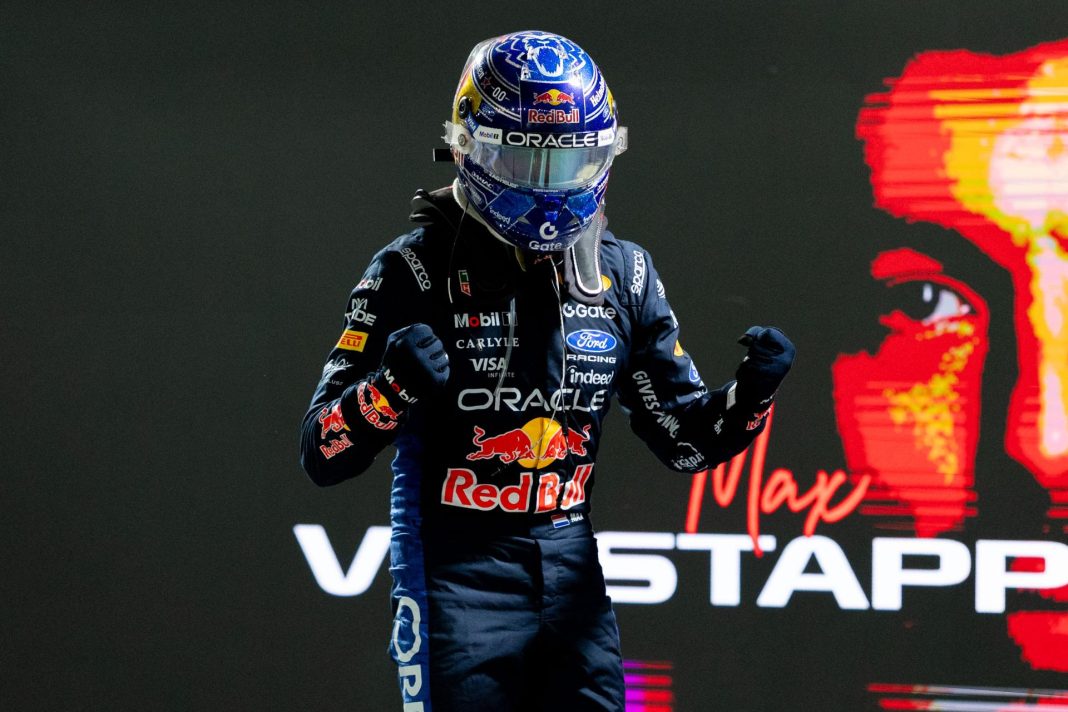

Max Verstappen made his mark at the 2026 Las Vegas Grand Prix, securing victory at the end of one of the most eventful races of the season. The Dutch Red Bull driver got the better of his rivals in a race characterised by constant overtaking, position changes and strategies centred on managing electrical energy. It was such an unusual scenario that it prompted the four-time world champion to draw a decidedly curious comparison.
When asked about his feelings during the race, Verstappen compared what happened on the Nevada street circuit to a game of Mario Kart, the famous Nintendo video game in which competitors can lose and regain positions in the space of a few moments.
Behind this quip, however, lies a deeper reflection on the characteristics of the new-generation single-seaters. According to the Dutchman, the ability to utilise slipstream and quickly regain speed thanks to the available energy made the duels particularly unpredictable, transforming every overtaking manoeuvre into a challenge in which battery management takes on fundamental importance.
It is precisely this aspect that has been one of the keys to Verstappen’s success. The Red Bull driver has sought to maintain a consistent position amongst the frontrunners, avoiding getting caught up in the most chaotic battles within the pack. This strategy is based on the ability to conserve sufficient energy to respond immediately to attacks from rivals, without giving them the chance to pull away.
Electric power management also proved decisive during braking phases and in close encounters, forcing drivers to continually adapt their driving style. Verstappen explained that he approached every duel with the aim of retaining the lead, even through particularly aggressive manoeuvres under braking.
Despite his success, however, the Dutch champion made no secret of his reservations regarding the 2026 Formula 1. Whilst he acknowledged that the new rules could offer an exciting spectacle for spectators, he also emphasised that the feel behind the wheel is profoundly different from the past.
For Verstappen, in fact, the constant back-and-forth of overtaking and counter-overtaking does not necessarily equate to greater competitive intensity. The Red Bull driver said he approached the race with an unusual sense of calm, without feeling the tension that normally accompanies the most gruelling battles.
This observation reignites the debate over the technical regulations introduced in 2026, with single-seaters in which the electric component and energy management play an increasingly central role. A change that has altered not only the teams’ strategies, but also the way in which drivers approach wheel-to-wheel duels.
The success in Las Vegas once again confirms Verstappen’s ability to adapt to the most complex situations and to maximise the potential of his car. At the same time, however, his comments represent a fresh sign of frustration with a Formula 1 which, whilst guaranteeing spectacular races, seems to be gradually moving away from the concept of competition that the Dutchman has always championed.
The victory stands, but Verstappen’s message is clear: spectacle cannot be the sole criterion by which to judge the quality of the races. And the comparison with Mario Kart, behind the irony, encapsulates all his concerns about the direction taken by the Formula 1.