

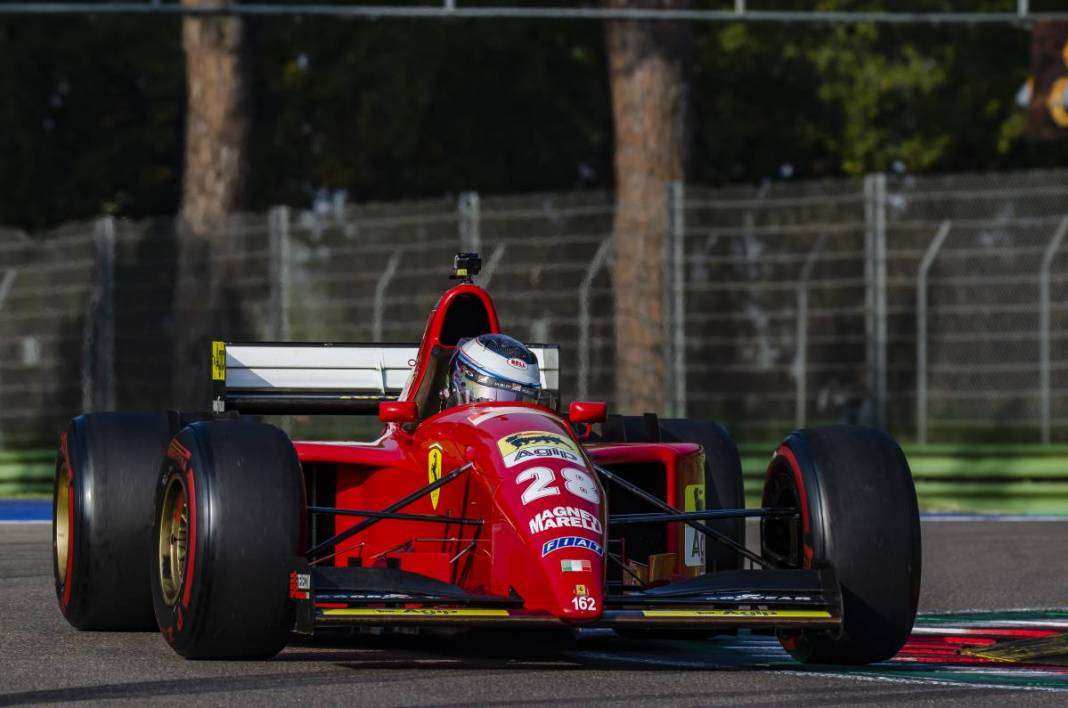

The Ferrari 412 T2 was meant to be Ferrari’s car of redemption. It almost succeeded, allowing fans of the Prancing Horse to dream of a glorious future. In the end, however, it remained just that—a dream. By season’s end, Jean Alesi and Gerhard Berger finished only fifth and sixth in the Drivers’ Championship.
In the Constructors’ standings, Ferrari secured third place, the lowest step of the podium, behind Benetton and Williams.
It was an inglorious conclusion for a single-seater that had been born with all the right credentials. The car was designed by John Barnard’s team, working far from Maranello at the Ferrari Design and Development (FDD) centre in Shalford, England.
The 412 T2 was beautiful—exceptionally so. Reliable and capable of delivering a consistent run of strong finishes unseen at Ferrari for some time, it also proved capable of outright speed, as demonstrated by Jean Alesi’s victory at the Canadian Grand Prix.
Alesi, in superb form and claiming his first Formula 1 victory, also secured three second-place finishes during the season. The 412 T2 featured a contrarian aerodynamic philosophy compared with other cars in the 1995 World Championship. It retained a V12 engine, introduced a steering-wheel-operated clutch and electronic throttle control, and was compact and agile. It remained competitive despite the significant regulatory changes introduced for 1995, including aerodynamic restrictions and a reduction in maximum engine capacity from 3,500 to 3,000 cc.
After a promising debut, however, development of the 412 T2 slowed and failed to keep pace. Above all, Ferrari had to contend with Michael Schumacher—the “seventh gear” of the Benetton—and the formidable Williams, which proved to be the most competitive car of the field, placing Damon Hill and David Coulthard second and third overall behind the German. For Ferrari, it was ultimately a season of unfulfilled promises, and the departures of Berger and Alesi at the end of the year—once unthinkable—became reality.
The Ferrari 412 T2 was designed by the FDD Shalford team (previously based in Guildford), led by John Barnard, often nicknamed “the genius,” who began full-time work on the new car in October 1994. Compared with its predecessor, the 412 T1, the T2 was smaller and shorter, with the engine mounted approximately 10 centimetres further forward.
This was made possible by reducing the fuel tank capacity to 140 litres.
“We were able to distribute weight more effectively between the front and rear axles,” Barnard explained. “Thanks to the more forward engine position, the 12-cylinder engine—normally bulkier than other layouts—is less penalised than in the past.”
The Ferrari 412 T2’s engine was entirely new. Seventy-five millimetres shorter than the previous 3.5-litre V12, the new three-litre unit was capable of extremely high revs, in the region of 17,000 rpm. Official power figures were never released, but highly reliable sources suggested output of at least 720–730 horsepower. One of the most significant innovations was the use of a steel engine block instead of cast iron, reducing weight by around one kilogram. Alongside the V12 programme, Ferrari also pursued a V10 engine, though it was not ready in time for the 1995 season.
The throttle was fully electronic, with no cables or linkages. The pedal actuated a sensor directly connected to the engine control unit, improving power delivery and easing the driver’s task. The traditional clutch pedal was eliminated, used only for starts and replaced by two paddles on the steering wheel. Gear changes were also controlled from the wheel via paddles mounted behind the spokes, operating a six-speed transverse semi-automatic sequential gearbox under electronic control. As regulations required the driver to manually select each gear, paddles were used instead of buttons.
The sidepods were shorter than those of the Ferrari 412 T1/B used during the second half of 1994 and housed the radiators, which were mounted vertically and inclined toward the rear.
At the back, the Ferrari was wider than its rivals and, unlike them, did not feature the typical tightly tapered shape behind the engine.
What were Alesi’s impressions of the car on the eve of the 1995 season, when the Avignon-born driver—who had joined Ferrari in 1991—had no idea he would leave at the end of the year?
“It’s very different to drive compared to the previous car, being shorter and more agile, especially through direction changes. The balance is neutral, with no particular weaknesses in any specific area: suspension, aerodynamics, chassis, gearbox or engine. Power has naturally dropped with the reduction in capacity, which makes the new Ferrari slower on the straights. On the other hand, the engine is smoother and easier to use. There are no traction problems even at full power thanks to the strong torque available.”
What was the secret to driving the Ferrari 412 T2 quickly?
“There are no real driving secrets. I can go flat on the throttle earlier, even mid-corner, and that saves valuable tenths of a second. Personally, though, I didn’t like the clutch on the steering wheel, because it requires an unnatural movement. It’s a small detail, but not insignificant. I also had issues with the two-pedal layout, as I had never used my left foot for braking, so I asked to keep the traditional clutch pedal on my car.”
Despite positive intentions and optimistic claims, the Ferrari 412 T2 failed to disrupt the Benetton–Williams duopoly. Bad luck also played its part, preventing the Scuderia from capitalising on a potential one-two finish at Monza. Berger retired after a suspension failure on Alesi’s car—then leading the race—caused debris to strike his teammate’s Ferrari, while Alesi himself was forced to retire from the lead due to rear brake problems.
The Ferrari 412 T2 marked the end of the V12 era in Formula 1. From 1996 onward, teams were forced to adopt V10 engines, followed by V8s from 2006 until the arrival of the hybrid era. With it also faded the most intoxicating soundtrack in racing—the ferocious, spine-tingling howl of the Ferrari V12. A melody that enthusiasts can still hear today at historic events such as Goodwood, the Minardi Day and the Ferrari Finali Mondiali.
Ferrari 412 T2 – Technical Specifications
Bodywork: Single-seater
Engine position: Rear
Drive: Rear-wheel drive
Dimensions and weights
- Overall dimensions (L × W × H): 4,380 × 1,995 × 980 mm
- Wheelbase: 2,915 mm
- Track: Front 1,690 mm – Rear 1,605 mm
- Fuel tank: 140 L
- Weight (race-ready): 595 kg
Engine
- Type: Ferrari Tipo 044/1 V12, 75°
- Displacement: 2,998 cc
- Valve gear: DOHC, 4 valves per cylinder
- Fuel system: Magneti Marelli digital electronic injection
- Power: approx. 700 hp (about 515 kW)
- Ignition: Magneti Marelli static electronic
Transmission
- Clutch: Triple carbon disc
- Gearbox: Ferrari transverse gearbox integrated with engine, 6 speeds + reverse, electronically controlled semi-automatic sequential
Chassis and running gear
- Chassis: Carbon-fibre composite honeycomb monocoque
- Steering: Power-assisted rack and pinion
- Suspension:
- Front: Independent, double wishbones, push-rod, torsion bars, telescopic dampers
- Rear: Independent, double wishbones, push-rod, torsion bars, telescopic dampers
- Brakes: Carbon ventilated discs front and rear
- Tyres: Goodyear
- Wheels: 13-inch BBS light alloy
Photos: Mazzocco Alessio / Giornalemotori