

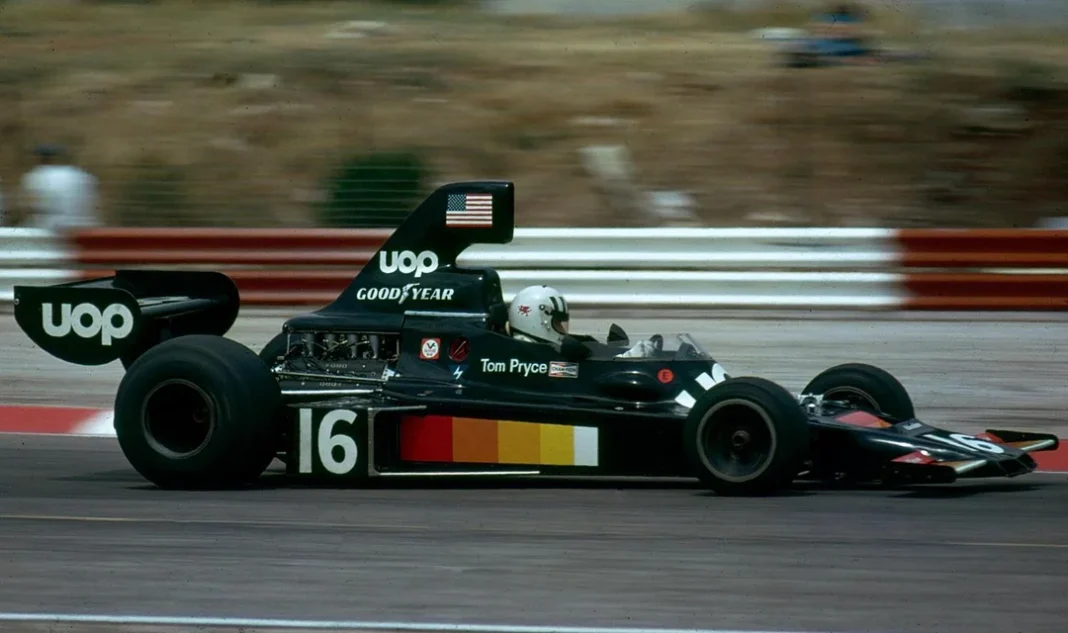

In the motorsport of the 1970s, an era of maximum regulatory freedom and rapid technological evolution, the Shadow team represented one of the boldest technical experimentation laboratories ever seen on track. Founded in 1969 by Don Nichols, a former U.S. Army officer and military intelligence expert, Shadow began as an independent operation with a clear objective: to seek performance through unconventional engineering solutions.
Nichols conceived Shadow as a technical project before it was a sporting one. Imitation was not an option: every car had to explore alternative directions, even at the cost of immediate competitive results.
Historical context and team structure
Shadow operated through the company Advanced Vehicle Systems, characterized by a lean but highly specialized structure. The team’s ability to compete internationally came largely from the industrial relationships Don Nichols built in both the United States and Japan, which allowed access to technical resources otherwise difficult to obtain.
Key partners included Firestone, involved in developing competition‑specific tires, Chevrolet, supplier of robust V8 engines, and a selected network of chassis and component manufacturers, chosen for quality and reliability. This network allowed Shadow to integrate advanced components while maintaining short development times and design flexibility.
Unlike large European constructors, with complex organizations and rigid hierarchies, Shadow compensated for its limited budget with rapid decision‑making, conceptual freedom, and immediate adaptability. This combination of technical skills, strategic vision and operational agility made it possible for the American team to successfully compete in both Can‑Am and Formula 1, achieving significant results despite a modest budget.
Extreme aerodynamics and reduced frontal area
The first Shadow presented in 1969 was one of the most radical attempts to reinterpret aerodynamic concepts applied to competition cars. The design focused on minimizing aerodynamic drag as the absolute priority, even before systematically pursuing downforce.
To achieve this, the car adopted a very compact overall configuration, with smaller diameter wheels and specially developed Firestone tires. This choice significantly reduced the body height and frontal area, with theoretical benefits in aerodynamic penetration. However, the extreme compactness and complex tire management made the dynamic balance of the car particularly critical, reducing its effectiveness in race conditions.
Although this did not lead to significant racing results, the first Shadow project was an important conceptual testbed, anticipating aerodynamic themes that would be developed in later years and confirming the team’s experimental and visionary technical philosophy.
Engines: power, torque and reliability
Throughout its racing history, Shadow stayed consistent in choosing Chevrolet naturally aspirated V8 engines. This was a deliberate technical decision, aimed at exploiting these engines’ robust torque over a wide RPM range rather than seeking extreme weight or sophistication.
The team’s engine philosophy prioritized traction and consistent performance throughout a race—key in Can‑Am competitions, known for high power and few regulatory constraints. In this context, reliability was as strategically important as performance.
DN4: a mature project
With the Shadow DN4, the team reached full technical maturity, moving from radical solutions to a rational and optimized approach. The aerodynamics became more conventional, with clean lines and carefully studied flow to maximize efficiency without compromising overall stability.
The chassis delivered rigidity and reliability, while the cooling system maintained consistent temperatures for over‑730‑hp engines, even in demanding races. The integration of chassis, suspension and powertrain allowed precise traction and power delivery.
On the track, the DN4 confirmed its effectiveness: in 1974 it took first and second place in the Can‑Am championship, beating McLaren, Porsche and Ferrari. This was a historic achievement for an independent American team and cemented Shadow’s reputation as a cutting‑edge technical laboratory.
Formula 1: rationality vs budget
In Formula 1, Shadow adopted a more rational design approach compared with its radical Can‑Am solutions. The DN5, DN8 and DN9 cars prioritized balance, solidity and predictability rather than risky or costly innovations.
Technical focus was on overall aerodynamic efficiency, with clean lines and flow for high‑speed stability. The chassis was designed for predictable handling, allowing consistent suspension behaviour and a neutral cornering attitude.
Despite limited resources, the team achieved notable results: victories by Tom Pryce in 1975 and Alan Jones at the 1977 Austrian GP showed that rational design and solid construction could compete effectively against better‑funded teams.
The tragedy at Kyalami
One of the most tragic moments in Shadow’s history occurred at the 1977 South African Grand Prix at Kyalami, when Tom Pryce, a talented driver and technical reference for the team, died in a terrible crash.
The accident unfolded when a track marshal crossed the circuit to assist another driver during the race. Pryce could not avoid the impact, and both he and the marshal were killed instantly. This tragedy remains one of the most painful episodes not only in Shadow’s history but in all of Formula 1.
Shadow team key data
| Year | Car | Series | Engine | Power | Notable Achievements | Key Drivers |
|---|---|---|---|---|---|---|
| 1969 | Shadow MkI | Can-Am | Chevrolet V8 | ~600 hp | Radical aerodynamic concept; testbed | Multiple drivers |
| 1971 | Shadow DN2 | Can-Am | Chevrolet V8 | ~620 hp | Early competitive entry | Multiple drivers |
| 1974 | Shadow DN4 | Can-Am | Chevrolet V8 | 730+ hp | 1st & 2nd in Can-Am championship | Jackie Oliver, George Follmer |
| 1973 | Shadow DN5 | F1 | Cosworth DFV V8 | ~485 hp | F1 debut | Peter Revson, Jackie Oliver |
| 1975 | Shadow DN5B | F1 | Cosworth DFV V8 | ~485 hp | Victory – Tom Pryce, 1975 Race | Tom Pryce, Jean-Pierre Jarier |
| 1977 | Shadow DN9 | F1 | Cosworth DFV V8 | ~500 hp | Victory – Alan Jones, 1977 Austrian GP | Alan Jones, Tom Pryce |